
The Day of the Intervention
The intervention started quite slowly. During the first 30 minutes at Granary Square, there was almost no one willing to join the bracelet-making activity. After this initial period, engagement started to increase slightly, with more people stopping to interact with the activity. However, a large part of this engagement came from children, who were interested in the beads and the process but were not part of my intended audience of London residents aged 18 and above. Over approximately two hours, I was only able to involve three adult participants.
This made me reconsider the location and the type of environment in which I was asking people to give their time and engage with the activity. I moved the intervention to Regent’s Park, where I thought people might be more comfortable slowing down, spending time on an activity and sharing their thoughts and experiences. This change in location made the intervention more successful, and I was able to involve eight adult participants. This also showed me that the physical and social context of an intervention can influence how willing people are to participate and how much time they are willing to give to an activity.
I had prepared a 25-question survey to use alongside the bracelet-making activity. However, rather than requiring participants to complete the questions in a formal survey format, I also offered the option of going through the questions as a discussion for those who preferred a more conversational approach. This allowed participants to explain their thoughts in their own words and made the interaction feel less structured when appropriate. I could therefore use the same questions as a framework while adapting the way they were delivered depending on the participant.
Choice
Participants were given the freedom to choose their own colours, beads and combinations without being given predetermined meanings. I wanted to see what people would naturally gravitate towards and whether their choices were based on personal preference, aesthetics or existing associations. Participants selected a wide range of colours, with many initially choosing colours simply because they liked them or felt that they worked well together.
Process
The decision-making process was often more revealing than the final bracelet itself. Participants experimented with different combinations, changed their minds, rejected certain colours and rearranged beads as they saw the bracelet developing. This showed that colour preferences were not always fixed from the beginning. In some cases, meaning and preference developed through the act of making rather than being something participants already had a clear idea about.
Meaning
As participants explained their choices, colours became connected to personal memories, emotions, relationships, personality and aesthetic preferences. Some participants also brought up cultural and gendered associations, while others were aware of these associations but distinguished them from what a colour personally meant to them. This became particularly important in understanding the difference between a colour having a socially recognised meaning and a colour having an individual meaning.
Identity
The bracelet-making process showed that colour could be used to express different aspects of identity. Some participants chose colours that they felt represented who they already were, while others chose combinations based on how they wanted to feel or how they wanted to be perceived. The process also created moments where participants reconsidered their choices and discovered meanings they had not initially thought about. This suggested that colour can be not only a reflection of identity, but also something through which identity can be explored and negotiated.
Audience
My intended audience was London residents aged 18 and above. The first iteration at Granary Square highlighted a difficulty in reaching this audience, as much of the engagement came from children rather than adults. Rather than treating this only as a problem with participation, I saw it as an opportunity to reconsider how the location affected people’s willingness to engage.
I chose Regent’s Park because I thought the environment might encourage people to slow down and be more comfortable giving their time and sharing personal thoughts. This proved more successful, with eight adult participants joining the activity compared to only three at Granary Square. Across both locations, I reached 11 participants aged 21–55: six were in their twenties, three were in their thirties and two were in their fifties. Two participants had colour blindness and one was hearing impaired. Although the sample was small, the intervention allowed me to engage with adults from different age groups and observe how differently people approached colour, meaning and self-expression.
Here are the results of the workshop:
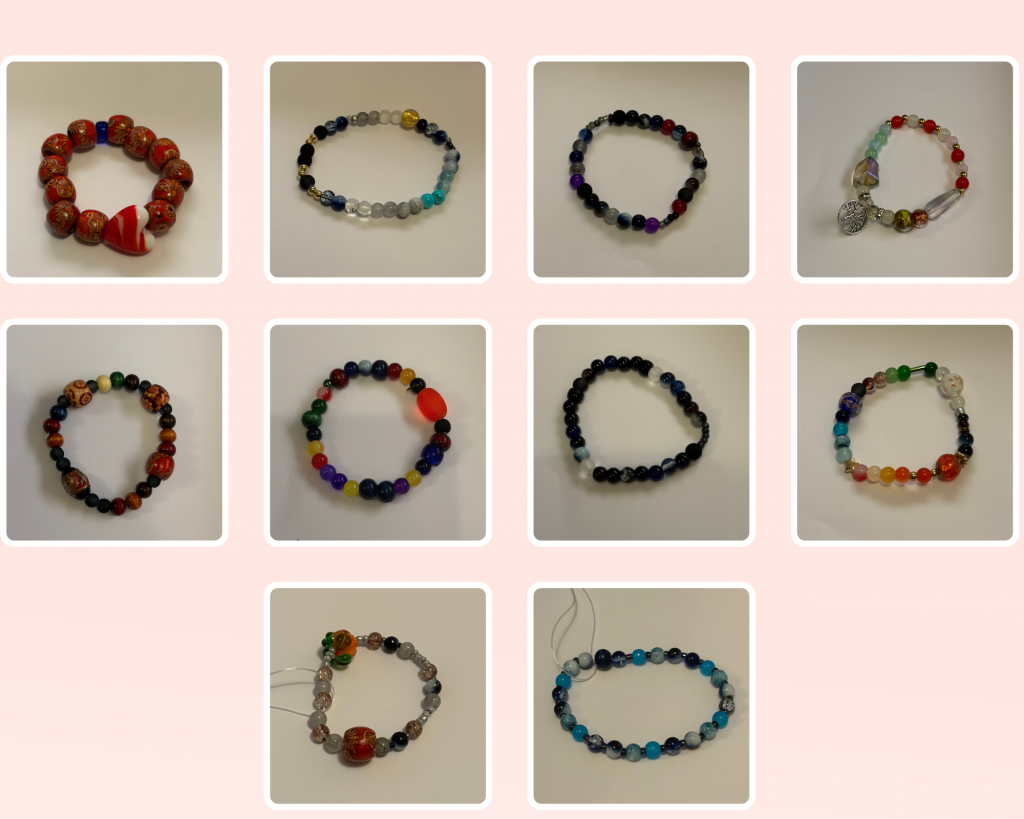
Next, I would like to add the 25-question survey I had prepared for the day alongside the prompts and the poster I prepared for the workshop.
Questions
THE BRACELET
- What does your bracelet represent?
A person / A place / An object / A memory / An experience / A value / Other - Why did you choose to represent this?
- Why did you choose these colours? What do they mean or feel like to you?
- Was there a colour you were immediately drawn to? Why do you think you chose it?
- Was there a colour you deliberately avoided? What made you reject it?
- Was there a colour you kept going back to but did not use? Why?
- Was there a colour you avoided but ended up using? What changed?
- Are the meanings you associate with these colours mainly personal, or do some come from things you have learned from others, culture, media, or society?
Mainly personal / A mixture of both / Mainly learned / Not sure
COLOUR & IDENTITY
- What do these colours say about you?
- Which colour in your bracelet feels most connected to your identity? Why?
- Which colour feels least connected to your identity? Why?
- Do any of your colour choices relate to how you see yourself, how you want to be seen, or how you think others see you?
- If someone who did not know you looked at your bracelet, what would you want them to understand about you?
- What, specifically, would you want them to understand?
- Is there anything about you that your bracelet might communicate that you did not consciously intend?
- Do you like the bracelet you made? Why or why not?
CONSCIOUS & SUBCONSCIOUS CHOICE
- Please indicate how much you agree with each statement.
1 = Strongly disagree / 5 = Strongly agree
- The colours I chose reflect how I see myself.
- My colour choices communicate something about my identity.
- Some of my colour choices felt instinctive rather than deliberate.
- Some of my colour choices were influenced by associations I was not consciously aware of.
- Please indicate how much you agree with each statement.
1 = Strongly disagree / 5 = Strongly agree
- I have learned that certain colours are associated with particular genders.
- Social or cultural expectations have influenced my colour preferences.
- Some meanings I associate with colour come from my own experiences.
- Some meanings I associate with colour come from culture, media, or other people.
- Before this workshop, how much had you thought about why you choose particular colours?
1 = Never thought about it / 5 = Thought about it extensively - After completing the workshop, how aware are you of your own colour choices?
1 = Not more aware / 5 = Much more aware - Which choice in your bracelet feels the most intentional, and which feels the most instinctive or unplanned?
- Did your finished bracelet communicate what you originally intended? What, if anything, changed?
- Did the bracelet develop a meaning that you did not expect?
Yes / No / Not sure
FINAL REFLECTION
- What do you think your colour choices reveal about how you have learned to think about colour?
- Thinking about the bracelet you created, what do your conscious and subconscious choices reveal about how you think about and how you have been programmed to think about colour?


Leave a Reply