Topic Introduction
Over the past months I have been reflecting on a theme that I care deeply about, which is the growing distance between people. Contemporary society often feels increasingly individualistic, and with this shift there seems to be less empathy and understanding between individuals. Even though people may live very different lives, many emotional experiences intersect. These shared experiences often come from universal desires such as wanting to belong, wanting to be accepted, and wanting to feel seen and understood.
At the same time, certain social structures sometimes do the opposite and exclude individuals who do not conform to particular expectations. These dynamics can be especially visible in areas such as fashion, self presentation, and aesthetic choices. Clothing and colour often function as forms of self expression, yet they can also become mechanisms through which individuals are included in or excluded from certain social groups. Because of this, the project explores how visual elements such as colour, clothing, and everyday environments can function as symbolic representations of emotion, identity, and belonging.
Research Approach
An important aspect of this project is that it will be conducted as collaborative rather than extractive research. Instead of positioning participants as subjects that simply provide information, they will act as contributors to the creation of knowledge and representation.This approach is informed by the work of Linda Tuhiwai Smith, particularly Decolonizing Methodologies: Research and Indigenous Peoples. Smith critiques the extractive nature of many Western research traditions and argues for research practices that are more participatory and reciprocal (Smith, 1999).
In this project, participants will therefore actively shape how their emotional experiences and interpretations of colour are represented. This is especially important because colour does not carry universal meanings. Colours can represent different emotions, memories, rituals, or symbolic associations depending on cultural and personal context. Instead of assigning fixed emotional meanings to colours, the project will focus on how each participant personally interprets them.
I also apply Amulya’s idea of reflective practice as a way of turning everyday experiences into meaningful learning by looking at both challenging and successful moments to understand what works, what does not, and where my values might not align with my actions (Amulya, 2004). I prefer doing this in a more structured, long-term way rather than quick daily check-ins, mainly through questioning, revisiting experiences, and having conversations both with myself and with my interviewees. Alongside this, I draw on The Tipping Point, which suggests that ideas and behaviours spread like epidemics and reach a moment where change happens very quickly, driven by small actions and how memorable the message is (Gladwell, 2001). This shapes how I think about communicating my project, focusing on making ideas engaging and easy to resonate with.
Key References
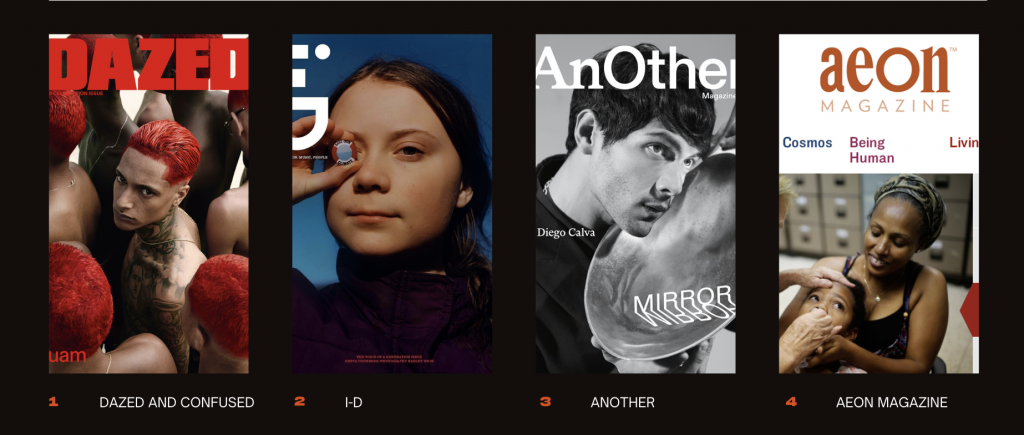
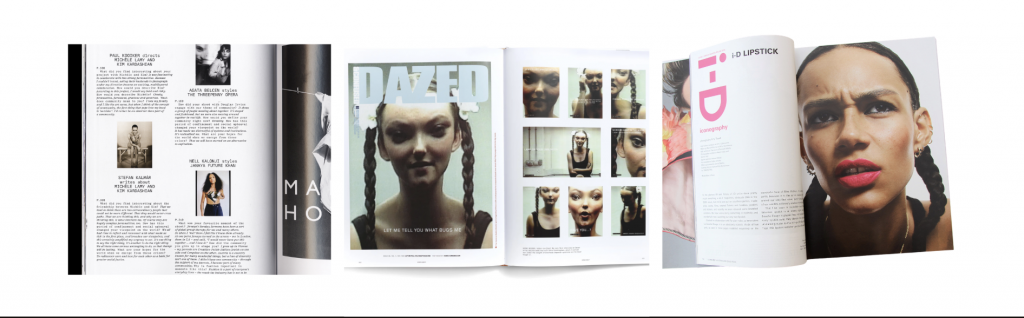
As part of the research process, I examined several editorial and cultural publications including i-D, Dazed, and Aeon. Each demonstrates different strengths: i-D focuses on interview-based storytelling around youth identity, Dazed combines fashion and experimental visual culture, and Aeon publishes research-driven essays on philosophical and cultural topics. While these formats highlight research, personal narratives, or visual experimentation individually, this project aims to bring these elements together within a single framework.
Colour and Visual Environments
An important theoretical reference for this project is Chromophobia by David Batchelor. Batchelor discusses how Western culture has historically marginalized colour, treating it as something excessive, irrational, or purely decorative (Batchelor, 2000).
He also questions common assumptions about minimalism being purely associated with white. When minimalism began to rise in the 1960s, artists were often working with bold colours, and even when white appeared it was rarely a single neutral white. Instead it existed as multiple variations interacting with other colours (Batchelor, 2000).


Batchelor raises a question that directly informs this project: if colour is considered unimportant, why has there been such a strong effort to exclude it? (Batchelor, 2000).
Project Outcomes
The project will result in a printed publication combining interviews, photography, research, and visual experimentation. Alongside this, a digital platform will present the same core material while allowing space for blog contributions, discussions, and events where participants can connect and exchange perspectives. The project will also extend into an interactive digital environment where users move through rooms containing objects, colours, photographs, and texts derived from interviewees’ emotional worlds. Interacting with these elements will transform the environment, immersing users in different emotional landscapes. Through these formats, the project aims to create a space where individuals feel recognized, understood, and represented through visual storytelling.
Bibliography
Aeon (n.d.) Aeon. Available at: https://aeon.co (Accessed: 15 March 2026).
Amulya, J. (2004) What is Reflective Practice? Massachusetts: Center for Reflective Community Practice, Massachusetts Institute of Technology.
Batchelor, D. (2000) Chromophobia. London: Reaktion Books. Available at: https://archive.org/details/chromophobia00batc_0/page/8/mode/2up (Accessed: 15 March 2026).
Dazed (n.d.) Dazed. Available at: https://www.dazeddigital.com (Accessed: 15 March 2026).
Gladwell, M. (2001) The Tipping Point: How Little Things Can Make a Big Difference. London: Abacus.
i-D (n.d.) i-D Magazine. Available at: https://i-d.co (Accessed: 15 March 2026).
Smith, L.T. (2012) Decolonizing Methodologies: Research and Indigenous Peoples. 2nd edn. London & New York: Zed Books.